

-
March 25, 2026
- 0 Comment
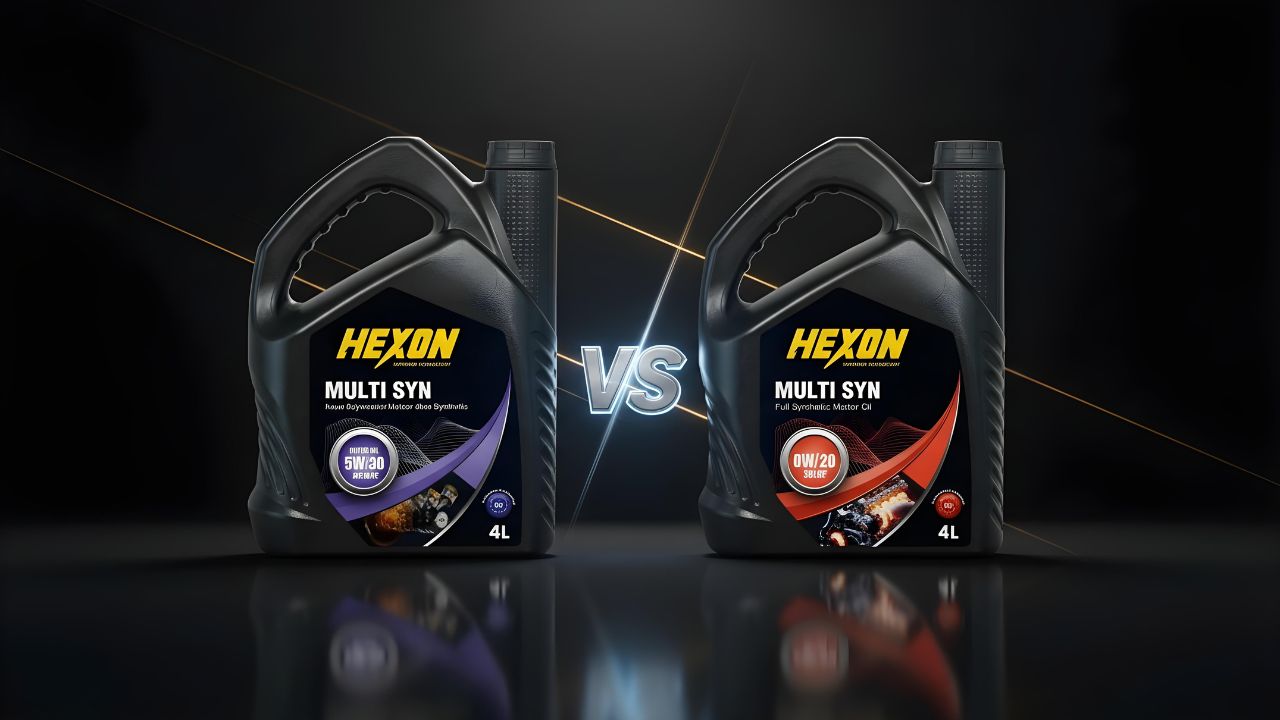
0W-20 vs 5W-30: Which Oil Is Better for Modern Engines?
Understanding the Numbers
Motor oil viscosity grades are defined by the Society of Automotive Engineers (SAE). The two-part code tells you how oil behaves at opposite temperature extremes.
The 0W means exceptionally low cold-start resistance — nearly like water at sub-zero temps. The 20 means it stays fairly thin at full operating temperature, reducing friction in tight modern engine tolerances.
The 5W still flows well in cold weather. The 30 means it maintains a slightly thicker film at high temps, offering a wider protection range across varied driving conditions.
The "W" stands for Winter, not Weight. It rates the oil's pumpability in cold temperatures — the lower the number, the faster the oil reaches critical engine parts on a cold start, when most wear actually occurs.
Side-by-Side Comparison
Here's how the two grades compare across the factors that matter most for everyday engine health:
| Property | 0W-20 | 5W-30 |
|---|---|---|
| Cold-Start Flow | Outstanding — fastest protection at startup Best in class |
Excellent — flows quickly in cold weather Very good |
| High-Temp Viscosity | Thinner film; ideal for precise OEM clearances | Slightly thicker — better buffer under heat and load |
| Fuel Economy | Higher efficiency — less drag on internal parts Advantage |
Marginally lower due to thicker film |
| Engine Type Fit | Modern GDI, hybrid, small-displacement engines | Broad range — older and newer petrol/diesel engines |
| Climate Range | Cold to moderate climates; with full synthetic, broad range | Cold to hot climates; more tolerant of heat extremes |
| Turbo Engines | Suitable if OEM-specified | Strong choice — holds up better under turbo heat Preferred |
| High-Mileage Vehicles | Works if manufacturer spec; may not seal older tolerances | Better for worn engines with wider clearances Preferred |
| OEM Adoption | Toyota, Honda, Mazda, many hybrids post-2015 | BMW, Mercedes, Volkswagen, Ford, GM and more |
Who Should Use Each Grade?
Your driving conditions and vehicle type matter as much as the viscosity numbers. Here's a practical breakdown:
- Your owner's manual specifies it
- You drive a newer Toyota, Honda, or Mazda
- You own a hybrid (Prius, Insight, etc.)
- You live in a cold climate with harsh winters
- Fuel economy is a top priority
- Your engine has very tight manufacturing tolerances
- Your manual recommends it (BMW, VW, Ford, etc.)
- You drive in hot climates or summer heat
- You have a turbocharged petrol or diesel engine
- Your vehicle has over 100,000 km on the clock
- You do regular towing or carry heavy loads
- You want a versatile all-season option
Always check your owner's manual first. Engine manufacturers specify viscosity grades based on internal tolerances, fuel injection systems, and emission targets. Using a thicker oil than recommended in an engine designed for 0W-20 can reduce fuel economy and put strain on the oil pump without any protection benefit.
The Impact on Fuel Economy
This is where 0W-20 has a genuine engineering advantage. Modern automakers — particularly Japanese manufacturers targeting strict fuel-efficiency regulations — engineered entire engine families around ultra-low viscosity oils. In these engines, switching from the OEM-specified 0W-20 to a 5W-30 can reduce fuel economy by 1–2% in real-world driving conditions.
For a vehicle covering 20,000 km per year, that difference adds up. However, if your engine was designed for 5W-30, using 0W-20 won't improve fuel economy — the thinner oil won't provide adequate film thickness for the wider manufacturing tolerances, potentially leading to accelerated wear over time.
The takeaway: the most fuel-efficient oil is the one your engine was built for, not the one with the lowest viscosity number on the shelf.
Synthetic vs Conventional: Does It Matter Here?
For both 0W-20 and 5W-30, the base oil quality makes a significant difference. Here's what to know:
0W-20 — Full Synthetic Only
You will almost never find 0W-20 in a conventional (mineral) formulation. Achieving a 0W cold-flow rating requires a fully synthetic base oil — the molecular consistency needed to remain pumpable at -40°C while protecting at 150°C+ simply cannot be achieved with mineral base stocks.
5W-30 — Available in All Formulations
5W-30 comes in conventional, semi-synthetic, and fully synthetic variants. For modern engines, full synthetic 5W-30 is strongly recommended — it delivers better thermal stability, cleaner deposits, and significantly longer drain intervals compared to mineral or semi-synthetic options.
At Hexon Lubricants, our passenger car engine oils are formulated with high-quality synthetic base stocks and advanced additive packages to meet or exceed OEM specifications — whether your engine calls for 0W-20 or 5W-30.
Climate & Temperature: Real-World Considerations
Cold Climates (below 0°C regularly)
Both oils perform excellently in cold weather, but 0W-20 has a slight edge at extreme sub-zero temperatures. For most European and Middle Eastern winters, both grades pump quickly enough to protect the engine within seconds of startup.
Hot Climates & Summer Driving
In sustained high-heat environments — think engine bay temperatures exceeding 120°C — the slightly higher viscosity of 5W-30 provides a more robust oil film. For drivers in hot climates who push their engines hard (or sit in heavy stop-and-go traffic for extended periods), 5W-30 offers a safer high-temperature buffer.
Mixed Climates (most of Europe, Turkey, and similar regions)
Both grades work well in temperate mixed climates. The deciding factor should be your manufacturer specification, not the local weather alone.
There Is No Universal Winner
0W-20 is the right oil for modern engines engineered to run on it — offering better cold starts and fuel efficiency. 5W-30 is the right oil for a broader range of engines, especially turbocharged, older, or high-load applications. The best oil for your engine is always the one your manufacturer specifies. When in doubt, open the manual — it's the most expensive lab test that's already been done for you.
Frequently Asked Questions
Can I use 0W-20 instead of 5W-30 in my engine?
Only if your owner's manual lists 0W-20 as an acceptable alternative. Engines designed for 5W-30 have wider internal clearances that require the thicker film to prevent metal-to-metal contact at operating temperature. Using 0W-20 in these engines can lead to long-term wear.
Is 0W-20 better for fuel economy?
Yes — but only in engines built for it. The lower viscosity reduces internal drag and can improve fuel economy by 1–2% in OEM-specified applications. In engines designed for thicker oil, using 0W-20 won't save fuel and may cause issues.
Can I mix 0W-20 and 5W-30?
You can in an emergency top-up, but it's not recommended as a routine practice. Mixing grades dilutes the performance characteristics of both oils and can affect the viscosity rating unpredictably. Always top up with the same grade specified for your engine.
Which is better for high-mileage engines?
Generally 5W-30. Older engines often have worn seals and wider clearances that benefit from the thicker film. There are also dedicated high-mileage 5W-30 formulations with seal-conditioning additives specifically designed for vehicles over 120,000 km.
Does Hexon Lubricants offer both grades?
Yes. Hexon offers a range of passenger car engine oils covering both 0W-20 and 5W-30 specifications, formulated to meet current ACEA and API standards. Visit hexonlubricants.com to find the right grade for your vehicle.